I love individual work stations. Having everything you need, in one spot, close by where you need to work, makes for greater efficiency as well as a pleasant experience. If you can group tools and their needs close together, you're more likely to work more safely, because you aren't tempted to overlook things and take short cuts.
The little roll-around cabinet below (subject of an article in the first issue of Woodcraft Magazine, January 2005) was designed to hold all the appurtenances and bits to go with my standing drill press. It also serves double duty as an adjustable infeed/outfeed roller stand for the table saw, band saw and drill press. I store a depth stop, screw extractors, files for sharpening bits, circle cutters, hole cutters, a hole-size gauge, and anything else pertaining to the drill press. It's one of those 'how-did-I-get-along-without-this' shop necessities.
And beneath my little workbench, I've added in a shelf to hold my portable sharpening station, a box to contain and protect a collection of oilstones:
It is french-fitted to loosely hold three grits of oilstones and is simple to just lift up onto the bench to work with, or to any other flat surface not buried under wood blanks or other tools at the time I need to sharpen chisels or plane irons or carving gouges.
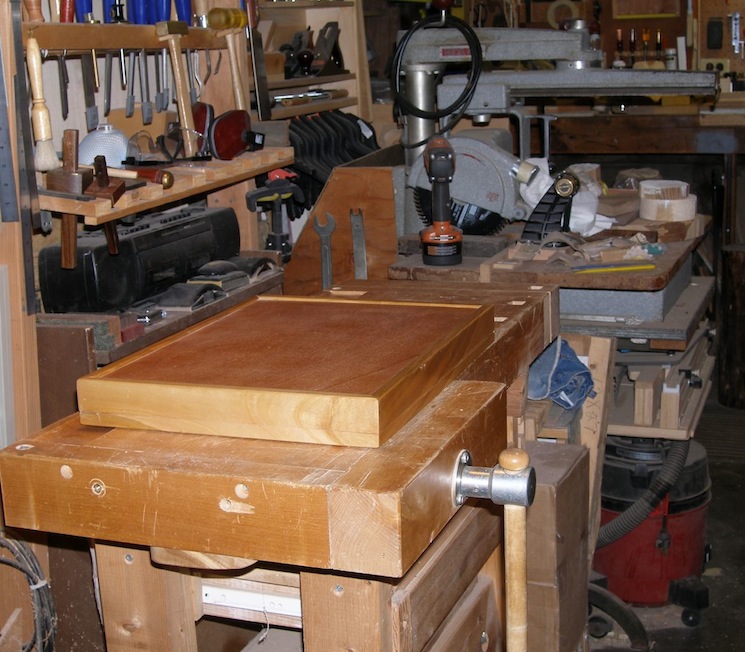
The stones lift out to wash away a build-up of swarf, or to turn them over for use, or to flatten against another. I included a small well for storing a slip stone and other miscellaneous sharpeners, and glued a wide leather strop to one end. There is also a steel plate for use with diamond pastes.
Having everything so easily to hand has made touch-up sharpening much easier, and I sharpen more often than I used to, when my supplies were scattered. The box keeps them clean, and can be used anywhere.
Work stations improve all my shop time. I have a unit for sandpaper storage, but need to do one for finishes and finishing supplies. It's on my list.
If you have any other innovative ideas for individual work stations, please share! I'm always open to new ideas for better shop efficiency.
©Barb Siddiqui, use with permission only
Monday, January 9, 2012
Tuesday, December 27, 2011
Old Fashioned Toys for the Holiday
Another Christmas has come and gone. The grandkids have gotten bigger, a new baby has been added, and everyone in the family wondered what I'd come up with for hand made gifts from the shop.
The really fun part of the holiday was that the kids found just as much fun in old-fashioned toys as they did in new electronic games! I made six small spin tops with colorful chatter work on both sides, top and bottom:
The kids had a lot of fun competing with them, and even got them to work upside down:
Then there were the Klopper Stompers, made of pine scrap drilled for a rope handle. Stomping among the wrapping papers became a sport of its own:
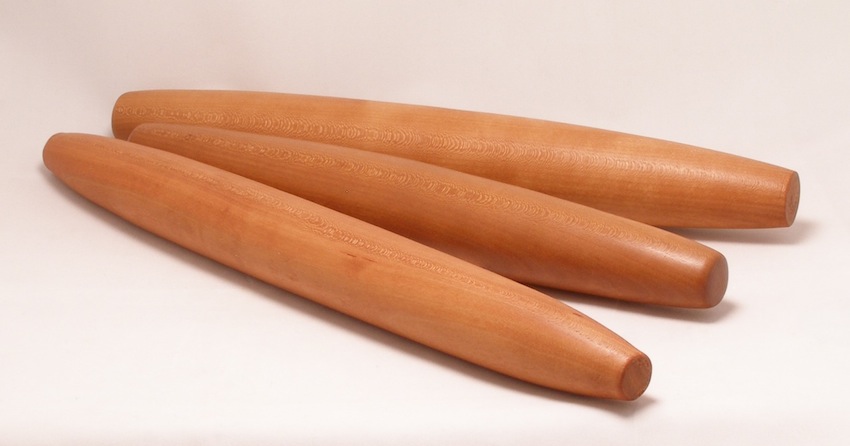
And for the adults, a few wine bottle coasters and French rolling pins made of local orchard Cherry:
What a great year! But, next time, I think I'll start making presents in August. It would relieve the stress level quite a bit. Happy Holidays to all, and here's to a great New Year!
Tuesday, November 22, 2011
Monday, November 21, 2011
It's All In the Process
My previous blog entry was one of 'Impatience For TheWork.' I had a piece of spalted birch on the lathe, and was anxious to get it hollowed out so I could start on newer pieces waiting for me. I completed the spalted birch piece with a red cedar collar:
The collar on it was intended to sweep upward in a beautiful cove, standing tall and polished above the spalted birch. In cutting it thin, I destroyed that idea with one dramatic catch, which cut a chunk out of the collar a full two inches down the cove I'd so lovingly completed. The collar, with much gnashing of teeth, then became a narrow rim. It was obvious after that, that I needed to make a lid for it.
The first lid was an ill fit, so I moved on to a second try. The second sported a thin, tall finial that comically looked too small on top of the vessel. The third lid was better, but it seemed to emphasize the fact I'd missed a 'fair curve' on the vessel itself. The outer curve flattens toward the bottom instead of continuing in a natural arc:
So, the vessel went back on the lathe over a jamb chuck, and I re-cut the bottom half, allowing the arc of the curve to sweep down to the base. It was only a small difference, but it made a big difference in the look of the turning.
I am learning to not get too impatient with what I'm trying to do, and I'm finally satisfied! The vessel is 10" tall overall, and is available for sale at BarbS Woodworks
Wednesday, September 21, 2011
Impatience for the Work
I'm wondering if other woodworkers suffer this malady: after thinking through design options and solving many problems, there seems to be a certain threshold that is crossed in thinking through the process of making something. It isn't intimidation, it isn't fear of failure, and it isn't really impatience. I think it is simply a lack of interest in the piece after the challenges are solved.
Before final completion, when I can at last 'see' what the finished product is going to look like, and when I know it is stable and no longer threatened with disintegration, I so often feel like setting it aside and getting on to the next one. Here's a vase form of spalted birch that I've set a narrow collar on, shaped and filled with ca glue and sawdust to fill small, unsightly gaps and flaws, sanded wet with oil and successfully hollowed out to about 3/4 of its depth.
Meanwhile I have to finish the spalted birch vase. I'm really just humming along trying to hurry the old project so I can get to the new. Having so much beautiful wood all at the same time is a curse, I tell you...it's a curse. Back to the shop!
Before final completion, when I can at last 'see' what the finished product is going to look like, and when I know it is stable and no longer threatened with disintegration, I so often feel like setting it aside and getting on to the next one. Here's a vase form of spalted birch that I've set a narrow collar on, shaped and filled with ca glue and sawdust to fill small, unsightly gaps and flaws, sanded wet with oil and successfully hollowed out to about 3/4 of its depth.
I'm anxious to get this thing completed and off the lathe. I've little interest in it now.
And this may be the reason, a 14" walnut blank 3" deep given by a friend, with another below it waiting to be assessed and its shape determined. Just look at the streaks of color in that side grain! I cannot Wait to get to it and see what it will reveal.
Meanwhile I have to finish the spalted birch vase. I'm really just humming along trying to hurry the old project so I can get to the new. Having so much beautiful wood all at the same time is a curse, I tell you...it's a curse. Back to the shop!
Thursday, August 18, 2011
'Feel Good' woodworking
Some days, the quiet attraction of this work is just soul-satisfying. The stresses of the world can close in on a person's daily life and make even a bright sunny day feel oppressive, but we woodworkers can always go to our 'cave' for some solace. Just sitting on a high stool and closing the eyes to take in the smell of natural wood shavings can fill the heart with what is real...can make one see forward to unhindered possibilities in creating something new. When I put a hand plane to wood, with the tool perfectly fettled for peak performance, and a consistent, full-width shaving peels off under my hand, the 'Ah-h-h-h factor' is a fine reward. I've kept a few, and used others for packaging or landscape bark. These few hanging in my shop, manage to bring a smile.
Woodworking is a completely tactile experience. It doesn't fade into the ether like software programming, outdated before its completion. Woodworking is the original 'hands-on' activity, designing and making something intended to last for generations. As skills improve, so do design concepts. There is always a new challenge to take on, new ideas to bring forth. Those curlicue ribbons of wood I've saved make me want to get back to designing something, building something, bringing something to life. The heart lifts, and it's all about the Potential Act. Onward then, while the weather is good and the day has just begun...
Wednesday, July 20, 2011
What Turners Call a 'Design Opportunity'
Finding bug-eaten holes deep through a work piece is always a disappointment. Deciding what to do about them puts one in a quandry that can last for days. This piece of Western Red Cedar looked sound as I prepared it for the lathe, but once the cutting began, it revealed a nasty flaw that would leave a 5/8" hole through the side no matter how I cut into it. I could have drilled a round hole and plugged it with the same wood. I could have filled it with colored epoxy. I could have left it alone and titled the piece 'What's Bugging Me.' Instead, I decided to let the flaw become a feature:
Adding a leather strip looped through the hole and decorated with jewelry baubles seemed a nice way to make up for an unattractive flaw. So, now it is a unique piece of artwork as well as a functional bowl. This is, in the Turning World, what is called a 'Nice Save.'
Subscribe to:
Posts (Atom)